Key points
- National Safe Work Month runs every October, and the 2026 theme is “Safe work is for life”.
- This list gives 31 toolbox talk topics, one for each day of October, grouped under the campaign’s four weekly themes.
- Each topic comes with one question to open a 5 to 10 minute discussion that ends with one agreed action.
- After each talk, record attendance and turn every hazard raised into an action with an owner and a due date.
- Body stressing and falls, trips and slips caused more than half of Australia’s 147,200 serious workers’ compensation claims in 2024-25, so manual handling and housekeeping talks are a good place to start.
Contents
Good toolbox talk topics are short, practical subjects tied to the hazards your team actually faces, such as hazard reporting, manual handling, fatigue, psychosocial risks and incident response. Below are 31 of them, one for each day of National Safe Work Month in October, each paired with a question to open the discussion.
National Safe Work Month runs every October, and the 2026 theme for Safe Work Australia’s campaign is “Safe work is for life”. A short daily toolbox talk, an informal safety conversation held on the job, is one of the simplest ways to keep that theme in front of your team all month.
The need is real: 222 workers died from traumatic workplace injuries in Australia in 2025, the highest number since 2012, and there were more than 400 serious workers’ compensation claims a day (Safe Work Australia, Key Work Health and Safety Statistics 2026). The topics below are grouped under the campaign’s four weekly themes, so the list doubles as a ready set of safety meeting topics.
These are practical toolbox talk ideas Australia-wide teams can adapt to any workplace. For wider campaign planning, see the Safety Champion National Safe Work Month 2026 resources.
How should you use these toolbox talk topics?
You can start these toolbox talk topics on any day; the list is not tied to a fixed start. Keep each talk to roughly 5 to 10 minutes: open with the prompt question, let the team answer, then agree on one action.
If you are not sure where to begin, start with the hazards behind the most claims. Body stressing, such as lifting, carrying and repetitive movement, caused 35.2% of serious claims in 2024-25, and falls, trips and slips another 22.2% (Safe Work Australia). The manual handling and housekeeping topics in Week 1 cover both.
Treat toolbox talks as a conversation rather than a lecture, and adapt each topic to your site, whether that is an office, warehouse, retail floor or field crew. Once October ends, the same list works as a rotation of daily safety talks for the rest of the year.
31 toolbox talk topics for every day of October
The toolbox talk ideas below follow the four 2026 weekly themes. Each line gives the topic, then one question to put to the group.
Week 1 (1 to 11 October): For life: why WHS matters
Start with the foundations every worker should know.
- Why safety matters: who relies on you getting home safely?
- Hazard reporting: what stops people reporting hazards here?
- Near misses: which recent near miss could have been an injury?
- Slips, trips and housekeeping: where are today’s trip hazards and clutter?
- Ladders and heights: when did you last check a ladder before climbing?
- Manual handling: which lift needs a second person or mechanical aid?
- PPE: is our PPE fitted, maintained and actually worn?
- Electrical safety: what do you do with a damaged lead or plug?
- Fire and evacuation: where is your nearest exit and assembly point?
- Confined spaces: which spaces here need a permit before entry?
- Speaking up: can you stop a job that looks unsafe?
Week 2 (12 to 18 October): For health: what WHS protects
Each day, pick one physical or psychosocial hazard and review its controls. Psychosocial hazards deserve the time: mental stress was behind 17,000 serious claims in 2024-25, with a median of 35 weeks off work, compared with 9.5 weeks for body stressing (Safe Work Australia).
- Hazardous chemicals: can you find the safety data sheet?
- Heat and hydration: how do we adjust work on hot days?
- Noise: where must you raise your voice to be heard?
- Fatigue: how do shifts and breaks affect alertness here?
- Workload: which deadlines push people towards unsafe shortcuts?
- Customer aggression: what is our plan when someone becomes aggressive?
- Respectful behaviour: how do we report bullying or harassment safely?
Week 3 (19 to 25 October): For the future: the long-term impact
Focus on injury and illness scenarios, how your team responds and how people recover.
- First aid: who are our first aiders and where is the kit?
- Incident response: what happens in the first hour after an injury?
- Dust and fumes: which tasks create airborne hazards?
- Ergonomics: which repetitive task could cause a long-term strain?
- Working alone: how do we check on isolated or remote workers?
- Return to work: how can we support a colleague returning after injury?
- Mental health: where can someone find support?
Week 4 (26 to 31 October): For all: action across all workplaces
Close the month by reviewing commitments and carrying actions beyond October.
- Contractors and visitors: does everyone on site know our safety rules?
- Vehicles and pedestrians: where do people and vehicles share space here?
- New workers: how do we induct and support new starters?
- Plant and equipment: which pre-start check gets skipped most often?
- Month in review: what did we learn, and what changed?
- Beyond October: which action will we keep going all year?
What happens after each toolbox talk?
Working through 31 toolbox talk topics will surface hazards and promised fixes, but nothing changes without follow-up. After each talk, record attendance and the main points raised, then turn each hazard into an action with an owner and a due date.
Report back at the next talk so the team can see what changed. Following through on your safety talk topics for work turns discussion into practical improvements.
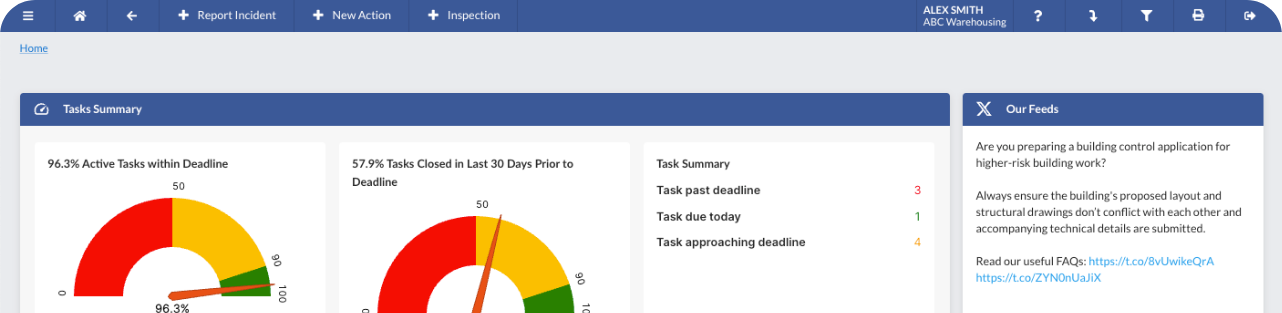
Safety Champion’s Safety Communications module lets you create templates for commonly used activities and confirm acknowledgement. The hazards and corrective actions module then tracks each action from identification to close-off.
Toolbox talk topics FAQ
These answers cover common questions to settle before leading your first talk.
How long should a toolbox talk last?
Most run for 5 to 15 minutes. Stick to one of the toolbox talk topics above and agree on one action before the group returns to work.
Who should lead a toolbox talk?
A supervisor or team leader usually leads, but rotating the presenter builds ownership across the team. Workers can also suggest topics based on what they see on the job.
Should toolbox talks be recorded?
Recording attendance and the actions agreed is good practice. Under the model WHS laws, a business must consult workers who are directly affected by a health and safety matter (Safe Work Australia), and a record helps show that consultation happened. It also makes your safety meeting topics easy to revisit.
Simplify toolbox talks with Safety Champion
The platform helps you send safety communications, confirm acknowledgement and track every hazard raised to close-off, so the toolbox talk topics you run this October lead to lasting change.
Whether you manage one site or multiple locations, Safety Champion streamlines compliance and protects your workforce.
Request a demo or start your free trial with Safety Champion Lite to see how the platform works for your organisation.